
































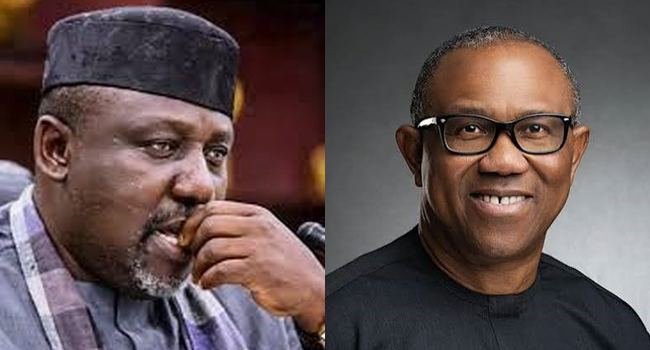
Former Imo State Governor Rochas Okorocha has described Peter Obi as a “fantastic gentleman” with a clear mind but dismissed the former Anambra governor’s pledge to serve only one four-year term as president as “four-year gambling,” prompting critics to question why a single term under Obi is considered a gamble while Nigerians are expected to endure eight years under President Bola Ahmed Tinubu’s APC administration amid persistent economic hardship and public dissatisfaction.
In a clip shared by Channels Television, Okorocha acknowledged Obi’s personal qualities but dismissed his single-term pledge as “four-year gambling,” raising questions about his position on the proposal and the political direction he supports ahead of the next general election.
“Obi is a fantastic gentleman; clear in his head. There’s nothing wrong with him, but we can’t do a four-year gambling,” Okorocha said.
Obi has repeatedly pledged to serve only one four-year term if elected president, presenting the commitment as a way to promote national unity, respect the rotation of power between the North and South, and focus on delivering measurable results rather than pursuing re-election.
Okorocha’s criticism has sparked debate, particularly among Nigerians who question why a one-term presidency is being portrayed as a gamble, given that the country has already endured years of economic hardship and public dissatisfaction under President Bola Ahmed Tinubu’s APC administration.
Critics argue that if a politician can acknowledge Obi’s character and leadership qualities yet still dismiss his four-year proposal, Nigerians deserve a clearer explanation of why the alternative is more reassuring.
The criticism also raises a broader question: Is Nigeria’s problem the length of a president’s tenure, or the quality of leadership and the results delivered while in office?
A four-year term is not automatically a gamble. Under a credible democratic system, a president should be judged by clear targets, accountability, and tangible improvements in citizens’ lives. Obi’s proposal invites Nigerians to consider whether a leader can make a meaningful difference without spending eight years in office.
For many of Obi’s supporters, the pledge represents an attempt to prioritise performance over political survival. They argue that a president who voluntarily gives up the possibility of re-election would have fewer incentives to focus on securing another term at the expense of governance.
Okorocha’s remarks come amid wider debates over political alliances in the South-East and whether regional politicians should prioritise alliances with the ruling party or support a different political direction.
The controversy has also revived criticism of politicians who appear to recognise Obi’s personal qualities but remain sceptical of his political proposals. For critics, praising a candidate while dismissing one of his central commitments raises questions about the basis of their political judgment.
Some Nigerians have interpreted Okorocha’s comments as evidence of a growing divide between sections of the political establishment and citizens seeking a different approach to leadership..
Ultimately, the debate goes beyond Peter Obi’s proposed four-year presidency. It challenges Nigeria’s political class to explain why a shorter tenure focused on measurable results should be considered riskier than an eight-year administration that fails to meet citizens’ expectations.
For Nigerians struggling with rising living costs, insecurity, unemployment and economic uncertainty, the central question remains: should a president be given more time simply because the Constitution allows it, or should the focus be on what the president delivers?