




























By Frontline Chronicle
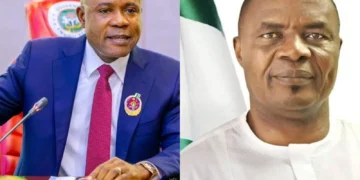
The Lagos State governorship candidate of the Nigeria Democratic Congress (NDC), Funso Doherty, has said that tackling the activities of transport touts popularly known as agberos in Lagos requires a government that is politically independent of the network and has the will to confront the interests sustaining it.
Doherty made the remarks during the Lagos Governorship Debate, where he described the agbero situation as a multidimensional problem requiring more than enforcement against individuals operating on the streets.
“The agbero situation is a multi-dimensional problem. The first step is: a government has to be elected outside of the agbero network, that is not beholden to the agbero network, and then you will have the political will to deal with it,” he said.
His comments point to what he considers a major obstacle to addressing street touting in Lagos: the alleged political and economic interests surrounding the informal transport network.
The NDC candidate argued that Lagos’s public transportation system remains poorly modernised, with thousands of ageing commercial buses still operating across the state.
He questioned why successive administrations had struggled to establish a more organised and efficient transport system, suggesting that vested interests benefit from the existing arrangement.
Doherty maintained that meaningful reform would require a government that does not depend on the agbero network for political support.
He also argued that tackling the problem should involve addressing the economic conditions that push people into street touting, rather than focusing exclusively on enforcement.
His proposed approach includes creating alternative employment opportunities through vocational training, skills acquisition and the modernisation of public transportation.
Under such a system, he said, people currently involved in informal transport activities could find legitimate employment as bus drivers, conductors, mechanics and other transport-sector workers.
Doherty’s comments have generated positive reactions among some Nigerians, particularly those who believe the agbero system has become a major problem for commuters, motorists and businesses in Lagos.
One commenter drew a comparison with Aba, claiming that the city had previously experienced serious agbero activity but had significantly reduced the problem. The commenter argued that Lagos could also address the situation if the political system sustaining it changed.
Others praised Doherty for directly addressing an issue they believe successive administrations have failed to resolve.
Some reactions also called on the NDC to build its campaign around the proposed reforms and mobilise support across Lagos communities.
The agbero issue remains closely connected to broader questions about public transportation, informal revenue collection, unemployment and political influence in Lagos.
Doherty’s position places political independence at the centre of his proposed solution, arguing that a government elected independently of the network would be better positioned to confront the interests sustaining it.
Whether the NDC candidate can translate that argument into a practical and enforceable policy remains a key question as political parties prepare for the 2027 Lagos governorship election.
For Lagos residents who face daily transport difficulties and alleged roadside collections, the debate goes beyond campaign promises. They want a transport system that is organised, affordable, accountable and free from intimidation.